Local police station
Anxious PeopleThe Local police station is the small-town setting where the hostage crisis becomes an investigation and where Jack and Jim confront the limits of their experience, their methods, and their relationship. On the day before New Year’s Eve, its interview room and staffroom hold two kinds of uncertainty at once: no one among the released hostages can explain what happened after they left the apartment, and the two officers cannot readily agree on how to handle a case unlike anything their town usually sees.
Setting and Routine
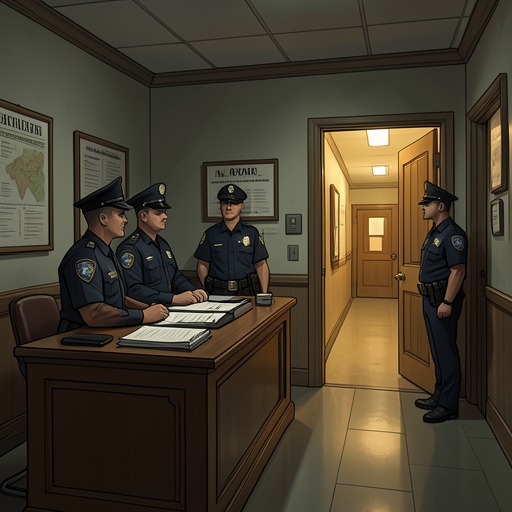
The station belongs to a town described as not particularly large and ordinarily quiet. Its scale matters: the officers are not accustomed to hostage dramas, and the building is too small for Jim and Jack to avoid one another. They work at desks facing each other, partly hidden by computer screens, in a police environment where much of the job consists of recording what has been done. The gap between the urgency of the crisis and the station’s routine paperwork gives the setting its particular pressure: the work must be documented even when the central facts remain out of reach.
The station’s interview room is the first sustained setting for questioning after the hostages have been released. The opening interview has already lasted fifteen minutes when the young officer asks the Real estate agent to answer directly. He appears barely twenty, while she looks older than forty; their clothing is mismatched in opposite directions, with his uniform too small and her jacket slightly too large. The scene establishes an awkward, strained exchange rather than a polished interrogation. When the officer asks whether the robber seemed accustomed to handling a pistol, the Real estate agent answers that the pistol was not real. Her breezy reply does not settle the matter; it leaves the officer trying to determine whether she is joking or mistaken.
The Investigation at the Station
After the hostages have been driven from the apartment to the station, the officers continue interviewing them while police gather outside the apartment. The witnesses do not know what occurred between their release and the police entry. A special negotiator sent from Stockholm calls the robber, receives no answer, and a shot is heard before officers enter. The station therefore becomes the place where accounts are collected after a decisive event that none of the interviewees can explain. Several hours of questioning do not resolve the uncertainty: at least one witness is withholding the truth.
The interviews repeatedly expose how the mechanics of questioning can become a source of friction. London sits on the floor because a phone-charging cable will not reach the chair, and objects when Jack treats moving the chair as an obvious solution. She insists that her ironic finger gestures be represented accurately in his notes, correcting his terminology in the process. When Jim questions Jules and Ro, Jack says he must speak to them separately; their conversation then becomes awkward over the phrase for being in a closet. These exchanges bring humor into the station’s procedure, but they also show that the officers do not fully control how witnesses answer, interpret, or redirect a question.
A later interview illustrates the same difficulty in a quieter form. Jim asks Zara how many prospective buyers were in the apartment, and she challenges the wording before he clarifies that he means the people who wanted to buy it. The station gathers testimony, but the record is shaped by the witnesses’ own definitions and evasions as well as by the officers’ questions. Zara’s account is especially consequential because her explanation of her apartment-viewing hobby conceals that she has been attending viewings for ten years and that the habit has become an obsession. Her silence about that history is part of the broader gap between what the station can record and what the people in the room are prepared to disclose.
Jim and Jack at Work
The station is also the shared workplace of Jim and his son Jack, whose generational differences appear in small habits before the crisis makes them consequential. Jim types slowly and checks each keystroke, wary of being tricked by a computer; Jack types rapidly without looking. They differ over search terminology and beer, and their familiar arguments make the station feel less like neutral territory than a confined family space. The computer screens only partly separate them, and the quiet of the town leaves Jim watching his son’s work while recognizing that the case is Jack’s chance to show what kind of officer he can be.
That opportunity becomes a source of mounting frustration. Jack was first into the apartment and believes one of the witnesses knows what happened. He fears that someone may still be hidden and in danger, while resenting the expectation that experts from Stockholm will take over. Lacking a starting point, he consults the internet about what to do in a hostage situation, despite having completed an active-listening course. The station records both his training and his uncertainty: the knowledge exists, but it does not supply an immediate way to establish contact with the robber.
Conflict and Significance
The tension between the officers breaks into the station’s ordinary work when Jim throws a coffee cup across the desks and it shatters against the wall. Jack has been furious about the investigation, but Jim’s outburst comes from his own frustration at being unable to help his son. Afterward, the two men fall silent; Jim apologizes and acknowledges that the situation is driving him to distraction as well. Their conflict is not simply a disagreement about investigative competence. The station makes their unequal positions visible: Jack must act under pressure, while Jim watches his son struggle and cannot remove the burden from him.
The building also frames the limits of the investigation. The officers collect testimony, compare accounts, and work through reports, yet the crucial explanation does not emerge through routine questioning alone. The station is where the mystery is pursued, not where it is immediately solved. Its cramped, familiar rooms and repetitive procedures contrast with the extraordinary stakes outside them, while its shared desks place father and son close enough to clash and, eventually, to recognize each other’s distress. As a setting, the Local police station gives the crisis an intimate institutional scale: the response depends not on an experienced specialist team already at hand, but on two local officers trying to make sense of events together.